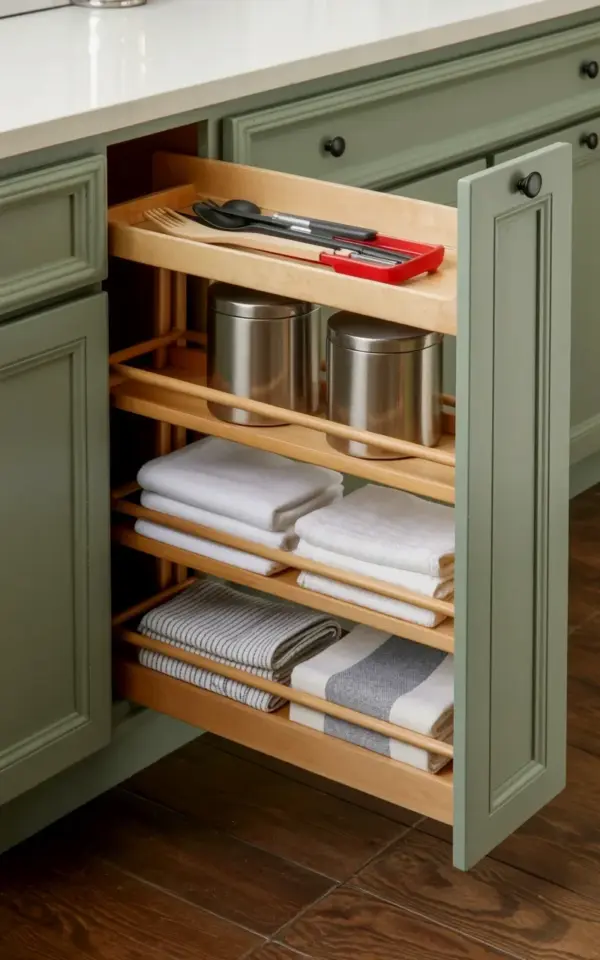
Picture a sage green cabinet with black knobs. When you pull the handle, four wooden shelves glide forward on smooth runners. The top shelf holds wooden utensils in a red holder, the second shelf has two stainless steel canisters, and below are neatly folded white towels and striped dishtowels. That is the promise of a pulloutcabinetorganizer, and it turns a spring kitchen refresh into a daily pleasure.
But getting there is not always simple. Many people install a pull out cabinet organizer and end up frustrated with wobbly shelves, wasted space, or items that fall off every time they slide it open. The secret lies in avoiding a few common mistakes. This guide walks you through what to watch for, using the exact setup from the photo as the gold standard.
Mistake #1: Measuring the Cabinet Opening Instead of the Interior
One of the most frequent errors happens before you even buy anything. People measure the visible door frame and assume that is the width of the interior. In reality, hinges, side braces, and the back panel all reduce the usable space. A slide out organizer that fits the opening can still jam against a hinge or stick out too far.
Always measure the inside of the cabinet from side wall to side wall, then from the bottom to the top, and finally from the front face to the back wall. Subtract a small clearance on each side, usually about half an inch, so the shelves slide without scraping. In the sage green example, the wooden shelves fit flush inside the frame with just enough room to move freely. That careful measuring is what makes the whole spring kitchen feel tidy and effortless.
Mistake #2: Ignoring the Weight Limit of the Slides
Wooden shelves look lovely, but they are only as strong as the slides underneath them. Many people choose inexpensive slides that hold 50 pounds, then load them with heavy canisters, cast iron pans, or large bottles of olive oil. Over time, the slides bend, the shelves tilt forward, and the entire organizer becomes unsafe to use.
Before you assemble anything, check the manufacturer’s weight rating. For a four-shelf pull out organizer like the one in the photo, look for slides rated at least 75 to 100 pounds per set. The second shelf in the photo holds two large stainless steel canisters, which can easily weigh several pounds each. With proper slides, that shelf glides smoothly without any wobble, even when fully loaded.
Mistake #3: Forgetting to Plan Shelf Heights for Different Items
A pull out cabinet organizer is only helpful if every item fits without stacking or cramming. The classic mistake is keeping the spacing between shelves equal. That leaves tall canisters leaning sideways or folded towels squeezed into a gap that is too narrow. The better approach is to group items by height and then adjust the shelves accordingly.
In the photo, the top shelf holds tall wooden utensils and a red holder, so it gets the most vertical clearance. The second shelf has canisters, which also need height. The lower shelves are shorter because folded towels and striped dishtowels are flat. If you can adjust the shelf positions, do that before attaching the slides. Measure the tallest item for each zone and add an inch of breathing room. This simple step turns cabinet organization from frustrating to genuinely functional.
Mistake #4: Skipping the Front Panel or Handle Placement
The whole beauty of a pull out organizer is that you can grab it and pull. Forgetting to install a front panel or placing the handle in the wrong spot makes this awkward. Some people skip the panel entirely and pull on the shelf edge, which strains the screws and feels uncomfortable. Others mount the handle too high or too low, forcing a bad wrist angle every time they open the cabinet.
A proper front panel, matched to the cabinet color, creates a seamless look. With the sage green cabinet and black knobs, the handle aligns with the existing hardware for a clean, custom appearance. When you plan your own pulloutcabinetorganizer, position the handle at a height that feels natural when you stand in front of the cabinet. Test it with an empty shelf first, then add your items and make sure it still opens smoothly.
Mistake #5: Overloading the Top Shelf or Leaving Items Loose
Even with a strong slide system, an overloaded top shelf can block your view of the lower shelves. This defeats the purpose of a pull out organizer, which is to see everything at a glance. Another common issue is leaving loose items that shift every time you slide the unit in and out. Small objects roll to the back, and the next time you open it, you have to fish around for them.
Keep the top shelf for lightweight accessories like wooden utensils, and reserve heavier canisters for the middle shelves. For smaller items like spice jars or measuring spoons, use small bins or trays that sit on the wooden shelves. The photo shows each shelf with a clear purpose: utensils on top, canisters on the second, folded towels on the third, and heavier striped dishtowels on the bottom. That even distribution not only looks better, it also prevents the organizer from tilting forward or getting stuck.
Mistake #6: Choosing the Wrong Wood Finish for Your Kitchen
Wooden shelves bring warmth and a natural feel to kitchencabinetstorage, but the wrong finish can clash with everything around them. A dark walnut finish might feel too heavy in a bright white kitchen, while a highly polished lacquer could look out of place next to matte cabinetry. The light natural wood with a smooth finish in the photo works perfectly against the sage green cabinet. It feels fresh, organic, and very spring-like.
When selecting your own shelves, look for wood that has been sealed with a food-safe finish. This matters because kitchen items like canisters, towels, and utensils come into direct contact with the surface. A good seal protects the wood from moisture, stains, and the occasional spill. Also consider the undertone of your cabinet color. A cool gray or blue cabinet pairs nicely with birch or maple, while a warm cream cabinet might suit oak or a walnut stain. Take a small sample of your cabinet color when you shop, so you can compare it side by side with the wood.
How to Get the Spring Kitchen Refresh Right the First Time
Start by emptying the cabinet completely. Wipe down the interior and measure everything carefully, not just the opening but also the depth and height. List all the items you need to store and group them by height and weight. That gives you a clear plan for how many shelves you need and how far apart they should be.
Next, choose a pull out cabinet organizer with wooden shelves that match your kitchen style and your budget. Order the correct size based on your measurements, and read the assembly instructions before making any modifications. Attach the slides to the cabinet walls securely, making sure they are level and parallel. Then add the shelves and test the movement with a few items.
Finally, arrange your items with intention. Place daily-use tools like wooden utensils at eye level, heavy canisters on the lower middle shelf, and linens on the bottom where they are easy to grab. Fold towels into neat thirds so they stack evenly. Use the red utensil holder or a similar container to keep small tools from rolling around. When everything has a specific spot, the organizer feels like part of the cabinet, not an afterthought.
A Simple Way to Keep the Momentum
Completing this project gives you that satisfying spring kitchen feeling, but the real reward is how easy it makes your daily routine. No more digging through a messy cabinet or forgetting what is hidden in the back. You open the door, pull out the wooden shelves, and there is everything, visible and within reach.
If you already have a pull out organizer that is not working well, do not rip it out. Start by removing everything and checking for the common mistakes listed above. Adjust the shelf heights, redistribute the weight, or replace the slides if needed. With small tweaks, even an existing unit can feel brand new.
For your next spring kitchen refresh, remember that cabinet organization is not about perfection. It is about creating a system that fits how you actually cook and clean. A pulloutcabinetorganizer with wooden shelves makes that system tangible, and with these mistakes in mind, you can enjoy a tidy, functional space all season long.
This post was researched and drafted with AI assistance, then personally reviewed and edited by Mia before publishing.
Leave a Comment