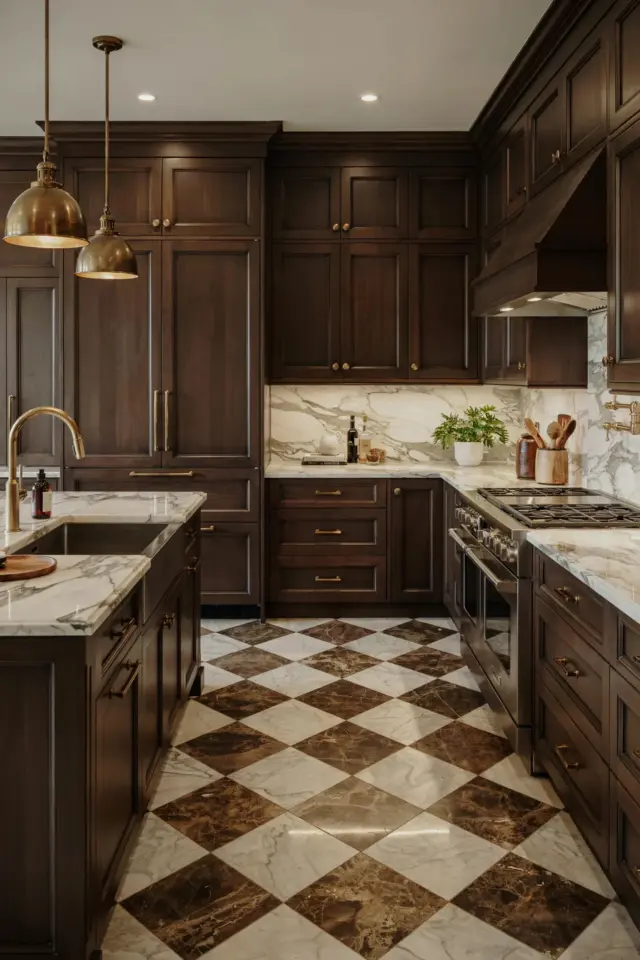
Right now, somewhere between your Pinterest boards and your saved posts, there’s a photo you keep returning to. It’s a moody walnut kitchen with checkerboard floors, a marble backsplash that catches the light, and brass fixtures that glow like tiny lanterns. I get it. I’ve pinned the same photo. What makes it work isn’t just the dark wood, it’s the balance of warm brown, creamy white, and that soft metallic glint. And honestly, the more I look at it, the more it feels like the perfect kitchen for the colder months. October through February, this room would just make you want to linger.
I have a thing for walnut. A couple years ago I spent an embarrassing amount of time at a lumber yard just running my fingers across a slab, feeling the way the grain ripples. There’s no other wood quite like it. It’s warm without being orange, rich without being pretentious. So when you pair walnut cabinets with these brown-and-cream checkerboard floors, something happens. The floor echoes the wood’s undertone, and the marble backsplash lifts all that darkness right back up.
Why a Walnut Kitchen Feels Like a Cozy Fall Hug
Let’s talk about the walnut itself. Walnut has this natural depth that painted cabinets just can’t fake. It’s not red like cherry, and it’s not as severe as ebony. It sits right in the middle, with a chocolatey brown that shifts from warm honey to deep espresso depending on the time of day. That’s part of why it feels so alive in a kitchen. The cabinets almost seem to glow when the afternoon sun hits them.
Another thing, walnut grain is busy, but in a good way. It gives your eyes something to trace, which matters in a room that’s mostly dark cabinetry. If you go with flat, matte wood doors, the grain becomes the texture, and it’s anything but boring. I’ve learned that in dark kitchens, texture is just as important as color. You need a little movement in the wood so the whole room doesn’t flatten into one big shadow.
Brown and Cream Checkerboard Floors: The Retro Comeback We Needed
The classic checkerboard floor has been around forever, but usually you see it in black and white. Black and white is crisp, sharp, and honestly a little cold for a moody room. The brown-and-cream version changes everything. It reads almost like a woven rug, and it softens the overall look without making the kitchen feel pastel or fussy.
I love that these are real tiles, not a giant decal. Small checkerboard tiles, maybe 12 inches or even 8 inches, create a sense of scale that feels both vintage and fresh. If you’re worried about slips, choose a matte finish or a slightly textured tile. And go with a lighter grout, not dark. The cream grout blends in with the cream squares and keeps the pattern from looking like a game board.
Marble Backsplash in a Dark Kitchen: How to Let It Shine
Walnut cabinets are heavy. No way around it. That’s why the marble backsplash is such a crucial player here. Whether it’s Calacatta, Carrara, or a honed Statuario, that white stone with those grey veins slices through the brown like a breath of fresh air. It doesn’t just decorate the wall. It bounces light around the whole room.
Here’s a practical tip. Use honed marble, not polished. Polished marble is shiny, but it shows every single water spot, and in a kitchen, that’s constantly. Honed has a softer, matte surface that still reflects light but doesn’t glare at you. Also, if you cook like I do, you’ll appreciate that honed marble hides the mess a bit better. Look, I once splattered tomato sauce on a polished marble backsplash and it left a faint pink ghost for a week. Not my best moment.
Brass Accents Are the Secret Handshake of Kitchen Design
Now the brass. This is where the design goes from pretty to actually pulled together. Unlacquered brass faucets and cabinet handles develop a patina over time, which sounds scary, but it just means the metal starts to look lived in and bespoke. If you’re not ready for that, use polished brass. Either way, brass gives you those little golden highlights that make dark wood feel rich instead of just dark.
Don’t stop at the hardware. A brass gooseneck faucet, a brass pendant lamp over the island, even the small knobs on a pot filler. These little moments catch the light and they work overtime at night. When the under-cabinet lights are on, the brass fixtures almost sparkle. Honest to goodness, it’s the easiest way to make an expensive-looking kitchen without adding more cabinetry.
Bringing This Look Home: From Full Renovation to Simple Swap-Outs
Some of you are planning the full remodel, and some of you are stuck with builder-grade beige for now. Either way, you can borrow pieces of this moody walnut kitchen without a total gut job. I’ve broken it down into a quick list of moves, from big to small.
- If your cabinets are solid wood, consider a dark walnut stain. It’s a weekend project, but the payoff is huge.
- No patience for staining? Swap out the doors entirely and keep the existing cabinet boxes, you can get walnut veneer doors for less than you’d think.
- Add a marble-look porcelain backsplash. It’s cheaper than real stone and much easier to clean.
- Put a checkerboard floor cloth or a washable vinyl tile in the center of the kitchen. You get the pattern without the permanence.
- Change every visible handle and knob to a brass finish. That one simple swap will shock you.
- Replace your overhead light with a warm-toned fixture. It’s not all about the wood, light temperature matters just as much.
That last one is something people miss. If your bulbs are cool white, even the most beautiful walnut cabinets will look flat and grey. Use 2700K or 3000K LEDs. Warm light makes the wood glow.
Seasonal Style: Making This Kitchen Cozy in Fall and Winter
This kitchen is already a seasonal dream, but you can lean in even further. In autumn, stuff a collection of dried hydrangeas into a burgundy ceramic vase and set it on the counter. The brown and cream floor picks up the dried flower tones, and suddenly it looks like your kitchen was designed around a November afternoon. In winter, swap in amber glass candleholders and a bowl of clementines, the orange against the dark walnut is pure magic.
What I really love is that the dark wood makes the season feel intentional. During Christmas, a small evergreen garland draped across the marble backsplash looks downright festive. In summer, this kitchen might feel a little heavy, but for the six months of cold weather, it’s the coziest gathering spot you can imagine. I keep coming back to the idea that a kitchen like this doesn’t just hold your pots and pans. It makes you want to stay in and cook something slow.
Before You Jump Into Dark Wood: A Few Reality Checks
I won’t pretend every dark kitchen works. Lighting matters more than anything, and if you only have one overhead fixture, this style is going to feel like a cave. You need layers, under-cabinet lights, pendants, maybe a small lamp on the counter. That’s non-negotiable.
Also, walnut is a softer hardwood. It dents easier than oak, so be gentle with heavy pots. And marble is porous, so seal it properly. The checkerboard floors will need a good scrub if you’re messy, especially with light grout. But here’s the thing. All of these are manageable. You just have to know what you’re signing up for. Nobody ever said a beautiful kitchen was the easiest to maintain.
Somehow, that’s part of the charm. A kitchen with real wood and real stone feels more honest. It can’t be wiped down with a magic eraser every day, but it also doesn’t look like it belongs to the internet. It looks like it belongs to a person who likes warmth, texture, and a little history.
So there you have it. I think this moody walnut kitchen with checkerboard floors and a marble backsplash deserves every single save on Pinterest
This post was researched and drafted with AI assistance, then personally reviewed and edited by Mia before publishing.
Leave a Comment