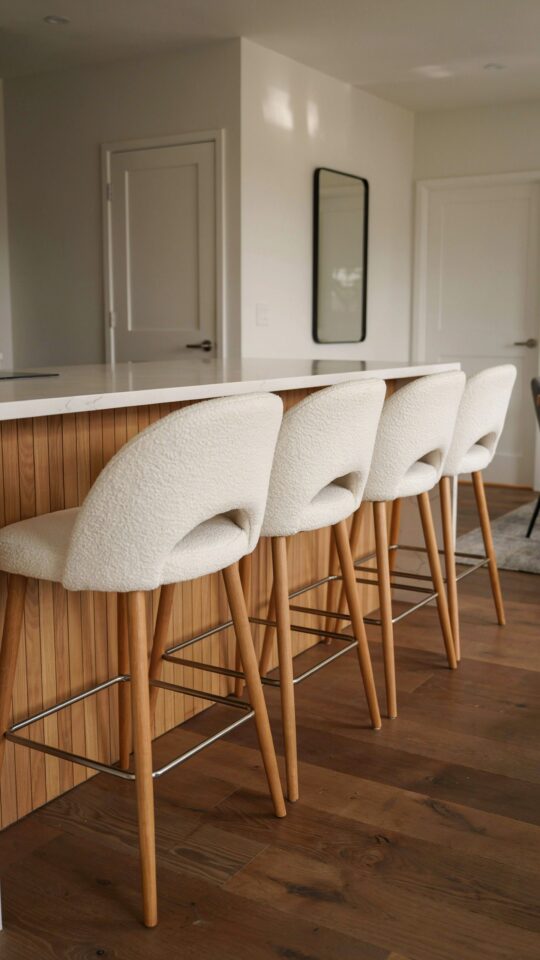
You scroll through Pinterest and see it: a tiny kitchen island wrapped in warm wood tones, topped with two perfectly plump boucle counter stools. It looks effortless, cozy, and like the kind of corner where real life happens. But when you try to recreate that look in your own home, something feels off. The stool is too tall. The island overpowers the room. The fabric pills after three weeks. I have made almost every mistake in the book, and I want to help you skip them. This small kitchen island design with boucle counter stools can absolutely work in your space. You just need to know which common pitfalls to avoid.
Mistake #1: Picking an Island That Swallows the Room (Small Kitchen Island Dimensions)
One of the biggest small kitchen design errors is choosing an island that is simply too large. You see a gorgeous 6-foot butcher block at the home store and convince yourself it will fit. Then you get it home and you cannot open the dishwasher or walk past the refrigerator. The result is a cramped, frustrating space instead of a cozy one.
For a small kitchen, aim for an island that is no wider than 24 to 30 inches deep and no longer than 4 to 5 feet. This leaves enough room for a 36-inch walkway on at least one side. If your kitchen is especially narrow, consider a slim rolling cart or a custom built-in that matches your cabinetry. A small island that fits properly will feel more intentional and functional than a bulky one that blocks everything.
Mistake #2: Guessing the Stool Height (Counter Stool Height for Kitchen Island)
Nothing breaks a cozy vibe faster than stools that leave your knees hitting the underside of the counter or your elbows awkwardly hovering. Standard counter height is 36 inches, which calls for stools with a seat height of 24 inches. But here is the tricky part: some islands have a raised bar overhang at 42 inches, and those need 30-inch stool height.
Before you buy anything, measure your countertop from the floor to the top of the counter. Then subtract 10 to 12 inches for the ideal seat height. That small gap between the seat and the counter is where comfort lives. Write the measurement on a sticky note and tape it to your phone. I promise you will thank yourself later.
- Check your overhang. You need at least 12 inches of overhang for knee clearance.
- Bring a chair pad. If you plan to add a cushion to a wood stool, measure with the cushion height included.
- Test before you buy. Sit on a stool at the store with your feet flat on the floor. Your thighs should be parallel to the ground.
Mistake #3: Buying Boucle That Breaks Down Quickly (Boucle Stool Fabric Durability)
Boucle looks incredibly soft and inviting, but not all boucle is created equal. Many budget stools use a synthetic blend that pills, snags, or flattens after a few months of daily use. If you plan to use your stools for breakfast, homework, and casual wine nights, you need a durable fabric.
Look for boucle that contains a high percentage of polyester or a polyester-nylon blend. These resist pilling better than pure wool or acrylic boucle. Also check the abrasion test rating; anything above 30,000 double rubs is good for residential use. If you can, ask for a fabric swatch and rub it firmly with your palm for 10 seconds. If little balls of fuzz form, keep looking.
For spills and sticky fingers, consider a boucle that is treated with a stain guard or choose removable cushion covers that can be dry cleaned. A little extra effort upfront saves you from replacing stools every year.
Mistake #4: Ignoring the Power of Soft Curves (Curved Boucle Counter Stools)
A straight-backed stool works in a modern, minimal kitchen. But for a cozy makeover, curves are your secret weapon. Soft rounded backs and gently shaped seats echo the texture of boucle and make the whole setup feel more human and less boxy. This is especially important in a small kitchen where hard lines dominate.
#SmallKitchenDesign #BoucleStools #KitchenIslandIdeas #CozyKitchen #CounterStools
This post was researched and drafted with AI assistance, then personally reviewed and edited by Mia before publishing.
Leave a Comment